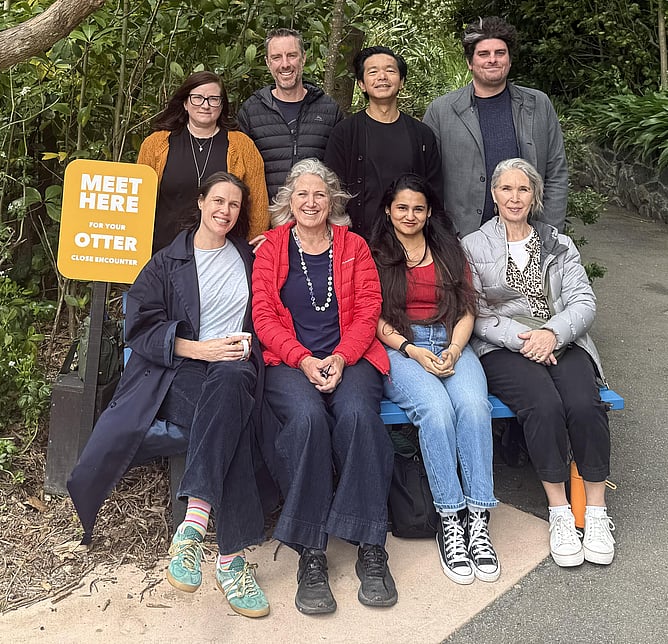
Veronica Stevenson (pictured bottom left with the Humble Bee Bio team) is the founder of Humble Bee Bio whose first product Elastrix™ is a bee-genome-derived bioactive peptide designed to stimulate elastin production and reverse visible signs of ageing.
Tell us about Elastrix™ and what makes it so special.
If your skin were a mattress. Collagen would be the foam and elastin the springs. Because elastin stimulation is such a rare effect almost all antiaging skincare works on collagen, the foam. But your body stops making elastin in early adulthood, and it's elastin that gives skin its bounce and ability to 'snap-back'. These qualities keep skin looking lifted, taut, and youthful. Elastrix is designed to target that gap.
Elastrix is a molecule we identified in the genome of an Australian solitary bee, and we synthesise it in a lab, so no bees are involved in producing it. Its first home is our showcase brand, Silk Doctrine. Named in honour of the bee silk that inspired Elastrix. In an 8-week study of 24 people using the Silk Doctrine patch, we saw a 31% reduction in the appearance of wrinkles, a 15% increase in firmness and a 28% improvement in texture, with visible results from four weeks.
And $2 from every box goes to indigenous-led conservation.
What inspired you to start Humble Bee Bio, and what were you hoping to achieve?
I had studied reproductive biology at university and learned about chemicals used in coatings and fibres that disrupt hormones, and cause cancer when they build up in our bodies and our environment. I wanted to replace them with something safer, so I looked to nature for materials with the same performance attributes. The R&D journey, the timing of the market and the regulatory tail winds have meant our first product is different from where we started out. But I always wanted to create something genuinely valuable that would be a force for positive change in the world, so we're sharing that value with indigenous-led organisations working to protect and restore biodiversity. This commitment is written into our constitution.
You started out designing picnic blankets! How did you transition from picnic blankets to a skincare ingredient?
I wanted to make an eco-friendly picnic blanket as a side hustle. It needed a waterproof layer. When I realised a non-toxic one didn't exist, and that connected to the chemicals I'd learned about in my reproductive biology degree I found myself compelled to tackle this much bigger problem. When I found that solitary bees line their nests with a silk that holds up against acids, heat and water, I bet my house deposit on researching it. We sequenced the bee's genome when investors still called synthetic biology science fiction, and we developed films and fibres that large companies were interested in.
Then the regulation driving that market was delayed and investment dried up. I could see it coming, so we tested our molecules on human skin. One of them stimulated elastin. That was Elastrix.
What have been the biggest challenges?
Deep tech is expensive, you can't bootstrap science the way you can SaaS. So I funded the company myself for the first seven years, while working and studying. Then there are setbacks you can't plan for. Our lab burned down mid-project, and we lost a lot of research. And market timing. We built a materials company and were ready to scale just as that market stalled, so we changed direction.
What have you learnt about raising money and getting people to believe in your idea?
For years I asked people to back a bee and a big vision, and I will always be grateful to our early stage Angels who funded the company when it was at its riskiest. What changed the conversation was data: a molecule, patents and the talented people on our team. We've now raised $10 million, but it took seven years of self-funding to reach our first outside investment in 2017, and until 2022 to be properly funded.
The other lesson is that markets move in cycles you don't control. A good company can be unfundable in the wrong year. So build a team and a product pipeline that can survive the cycle, and be honest with investors when the plan needs to change. Changing direction because the evidence tells you to isn't failure; it's part of the journey.
Have there been times you felt like giving up, and what kept you going?
Yes, many times. What kept me going was that the science remained promising, and the market was hungry. Every time I thought we'd hit the end, the next results would keep me going. There was also a big sense of responsibility. People invested in this, and we had a team building their careers on it. That's a hard thing to walk away from, and I'm glad I didn't.
What's been your proudest moment so far?
Watching the team rally behind the change in direction. Trying the Silk Doctrine patches for the first time. Close behind is writing our conservation mandate into Humble Bee Bio's constitution. Plenty of companies make promises about a positive impact on nature, we've codified our commitment.
You've gone from scientist to running a business and launching a consumer product. What's been the biggest learning curve?
I'm a scientist by training, but in reproductive biology however Humble Bee Bio required me to quickly learn enough about many different fields of science - etymology (study of insects), gene sequencing, bioinformatics, bioenginnering, fibres and films and now cosmetics. I'm lucky to have worked alongside deep domain experts in these areas who brought this product to life one experiment at a time. The next learning curve is turning this technical and scientific success into a commercial one.
What's one thing nobody warned you about?
On the roller coaster nature of entrepreneurship. No one warns you about what the ups and downs do to your mental health if you don't detach your sense of self-worth from the fluctuations of the business.
One piece of advice to your younger self?
Trust your instinct, and the evidence in front of you over the plan.
What's next for Humble Bee Bio?
Getting Elastrix to as many people as possible. That means licensing Elastrix to a global beauty partner, and bringing new products from our platform to market through our showcase brand, Silk Doctrine.
I'm really excited about deploying the conservation fund. The first distributions from the sale of the Silk Doctrine micropoint patches are planned for next year, with indigenous-led conservation partners we're working to confirm.
If you'd like to try Elastrix, use code SODASD10 for $10 off.